

Beyond Bruises & Blisters: Regina Cox cares for Belton High Students
By Tonya Warren | Photos courtesy of Belton ISD
It takes more than a village to keep approximately 1,750 Belton High School students and staff healthy, and while everyone else’s swimming suits may still carry the smell of chlorine from summertime pool fun, Belton High School Registered Nurse Regina Cox and her team are busy preparing for another school year of caring for energetic and busy teenagers.
According to a 2021 study published by the National Association of School Nurses, only 65.7% of schools have access to a full-time school nurse (RN/LVN). Cox is proud of the fact that an RN is present on every campus in the Belton Independent School District.
“On a typical school day, we see between 40 and 50 students for clinical visits,” Cox said.
She and her nursing staff, comprised of another RN and one licensed vocational nurse, work incredibly hard for students and staff to help ensure they’re healthy and safe throughout the school day and beyond.
Gone are the days when the job mainly consisted of temperature checks, verifying vaccine status and calling a parent to pick up their stomachache-ridden child. Certainly, those things will always be part of the job, but school nursing is no picnic.
“I use everything I learned in nursing school,” Cox said. “From my pharmacology knowledge, to knowledge I must have regarding diabetic care, emergency care to mental health issues and even stabilizing broken bones — we do it all.”
As a teenager, Cox saw firsthand the physical, as well as emotional, work that goes into nursing when her grandmother was diagnosed with terminal cancer. Noticing how knowledgeable and caring her grandmother’s home health nurses were helped set the stage for Cox to pursue a nursing career.
“My grandmother often told me that I’d make a great nurse, and I began believing what she said was true,” she said.
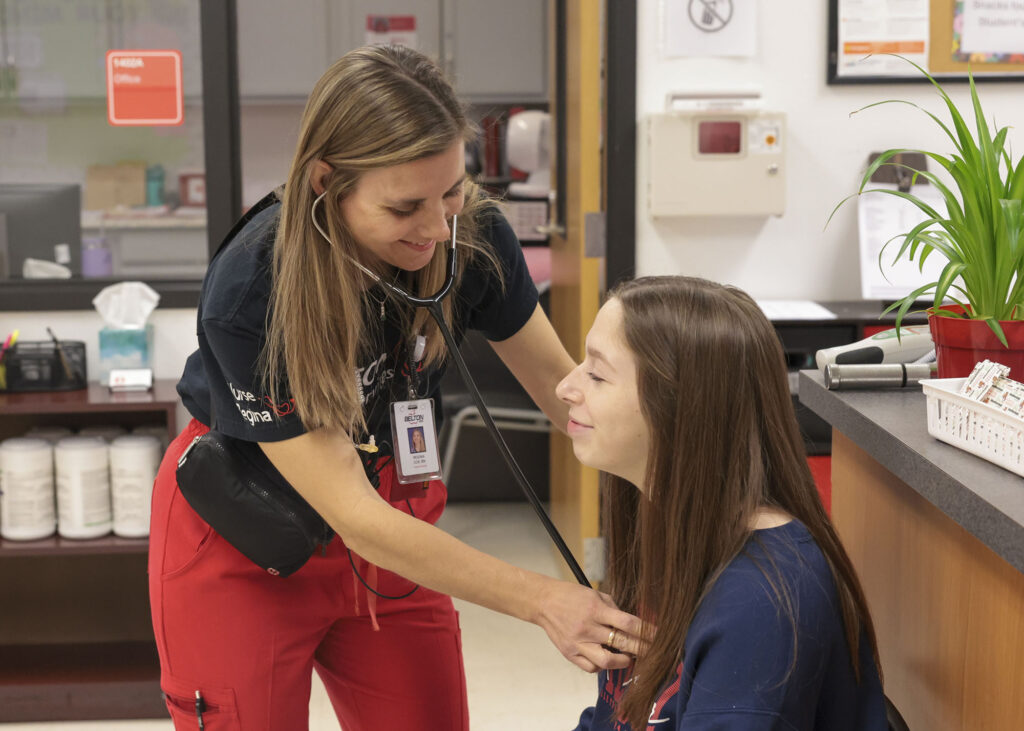
One of the many wonderful things about nursing is the ability to have a flexible schedule, so after completing her master’s degree and wanting to work part-time to mother her oldest child, she worked as an adjunct faculty staff for the University of Mary Hardin-Baylor. In 2015, when her youngest daughter began school, Cox said she began her adventure as a school nurse at her daughter’s Belton elementary school. In 2021, she transferred to the high school campus after serving the elementary school for six years.
Her years of experience have helped prepare her for whatever the day throws at her. While some issues are minor, others require more extensive treatment. Some chronic health issues Cox and her team manage are, but not limited to, asthma, diabetes and epilepsy. Students with tracheostomies (a tube in the throat creating an airway) require daily suctioning, cleaning and changing of the tubes. There are also students with gastric feeding tubes who need staff to manage their care.
“We also have students with bowel and bladder issues who need help with colostomy bags and urinary catheters,” Cox said.
Another important aspect of the job is finding time throughout the day to document the care given to each student and that student’s response to the care received. Did the bleeding stop with a pressure bandage? Did the headache become worse after the locker collision where students were horsing around? Did the parent ever bring an inhaler for their kids’ asthma after being notified twice the kid was out of their medication? Documentation is one of the most important aspects in any area of nursing.
“Not every student has health issues that require school nurse management.” Cox said, “but we do have 1,000 listed health conditions that we are aware of.”
School nurses also play an important role for students with health needs who leave campus for things like sporting events, University Interscholastic League competitions, band trips and more. They coordinate care and make sure teachers and sponsors know how to manage various health conditions and emergency medicines. School nurses also coordinate with families to provide daily medications on overnight field trips.
Every school year, Cox and her staff also train all staff on hands-on CPR/first aid/ and AED, Epi pen use, and Stop the Bleed. Also, since hands-only CPR is a high school graduation requirement, they teach students this, as well as AED training.
Student hearing, vision and scoliosis screenings are also part of the job. The school nurse is sometimes the only health care provider a student has access to, and referrals are made as necessary. Every RN is also on the campus safety and security team, and Cox also works with a school counselor to coordinate pregnancy related services to help students continue their education.
And sometimes there are issues below the surface in a student’s life that school nurses help treat. In 2024, the National Center for Education Statistics, which is responsible for collecting and reporting data on the condition of U.S. education from early childhood through adulthood, reported that on average, 19% of public school students utilize school-based mental health services.
Cox can certainly attest to today’s mental health challenges students face.
“Now, more than ever, students need access to mental health care,” she said. “And one of the greatest difficulties of school nursing today is mental health challenges for our students of all ages.”
Highly concerning is the number of students who battle depression, anxiety and even feelings of inferiority in high achieving students who feel stress in achieving and maintaining high performance expectations. Cox is proud of the fact that last fall, Belton High participated in the Mental Health First Aid training where her team learned more tools to assist students in undergoing a crisis.
“An important reminder is that no school is immune to drug use and the increased rate of self-harm or suicide,” she said. “It’s imperative school nurses stay abreast of the changing substances students’ access and the effect of those substances.”
In addressing this need, school nurses have the opportunity to attend a districtwide Safety Summit, and an annual nurse conference also covers this topic.
When asked what the greatest healthcare need facing students today is, Cox was quick to reply.
“My personal opinion is that students could spend less time on their phones and drinking less energy drinks.”
In addition, she said students could benefit from more time outside, getting exercise, and eating healthy meals at the dinner table with their families.
Cox and her team are more than just school nurses, they’re some of the students’ most avid cheerleaders and advocates, providing a listening ear or a shoulder to lean on. Cox sees her job as a calling.
“Thank you for entrusting your children to our care,” she said. “Your children are amazing, and we love them.”