

Santa’s Station: Behind the Scenes at a Fort Hood Holiday Tradition
By Amy Rognlie | Photos courtesy of Santa’s Workshop at the Great Place
 Spy. Soldier. Santa.
Dave Gauvey is all three and then some. A long-time Texan and Fort Hood’s Santa for more than two decades, Gauvey has lived more life in his 88 years than most folks.
“I’ve had a chance to live three different lives, and this is the best one yet,” Gauvey said.
Beginning with basic training at Fort Knox, Kentucky, in the 1950s, Gauvey served three years in the U.S. Army where, at 19 years of age, he put his photography skills to work as a spy. After that program ended, he was sent to Korea for a year, where he learned a lot and made lifelong friends.
After his stint in the Army, Gauvey was working two jobs when he decided to go to college at the age of 33. There, he was diagnosed with dyslexia, but that didn’t stop him from going on to earn not only his bachelor’s degree, but three master’s degrees.
Along the way, he climbed all the rungs of the corporate ladder in management and marketing while he continued to use his gift of photography and in the 1980s, taught himself how to use a personal computer. Personal computer usage was still brand new at that time, but Gauvey saw the value of the technology immediately. He also realized that virtually no one really knew how to use a computer.
“There were no books or instructions for regular folks,” Gauvey said. “Computers for Dummies was not written yet. They were all in code and written for tech people.”
True to form, he began to think about what could be done about the situation. Sitting through a statistics class every Wednesday night for months gave him time to think through what it would look like to have a computer-literate city. And after running the idea past a friend in local government in Winnsboro, Texas, a plan was born. Soon Gauvey hired a small team of teachers, purchased a movable trailer that could seat 14 students, and wrote all of the material to start teaching those in his community how to use a computer. He eventually wrote 24 how-to books on the topic.
“I figured we needed 64% of the working class in the city to know how to use a computer for us to be called ‘computer-literate’,” Gauvey said. “But after two years, 82% of our community workforce members could confidently use a personal computer. The Texas state senate officially declared the city the first computer-literate city in Texas.”
Around this time, twenty years after his stint in the Army, Gauvey went into the U.S. Army Reserves for five years, then did a year in the National Guard. At the same time, he worked for the state of Texas, taught for 20 years at various colleges and worked for 20 years in sales and marketing. Fast forward to the early 2000s, when Gauvey finally retired. It was around this time that he wrote a very special book entitled, Santa’s Socks. Set in a poor area of Chicago during the Great Depression, Santa’s Socks is a heartwarming book that highlights those who put their own needs aside to care for others.
“I was signing books at a bookstore in Dallas when a man came up to me and told me that I reminded him of the Santa from the 1947 classic Miracle on 34th Street,” Gauvey said. “He needed someone to play Santa for his non-profit ministry to homeless people, so I went out and bought a Santa suit, and the rest is history.”
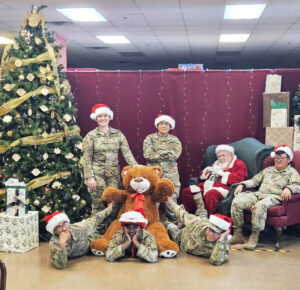 Gauvey started doing Santa jobs at various venues and corporate parties, never taking payment for himself.
“I would tell them that Santa doesn’t believe in getting paid for that job,” he said. “But I would let them donate to Santa’s Workshop.”
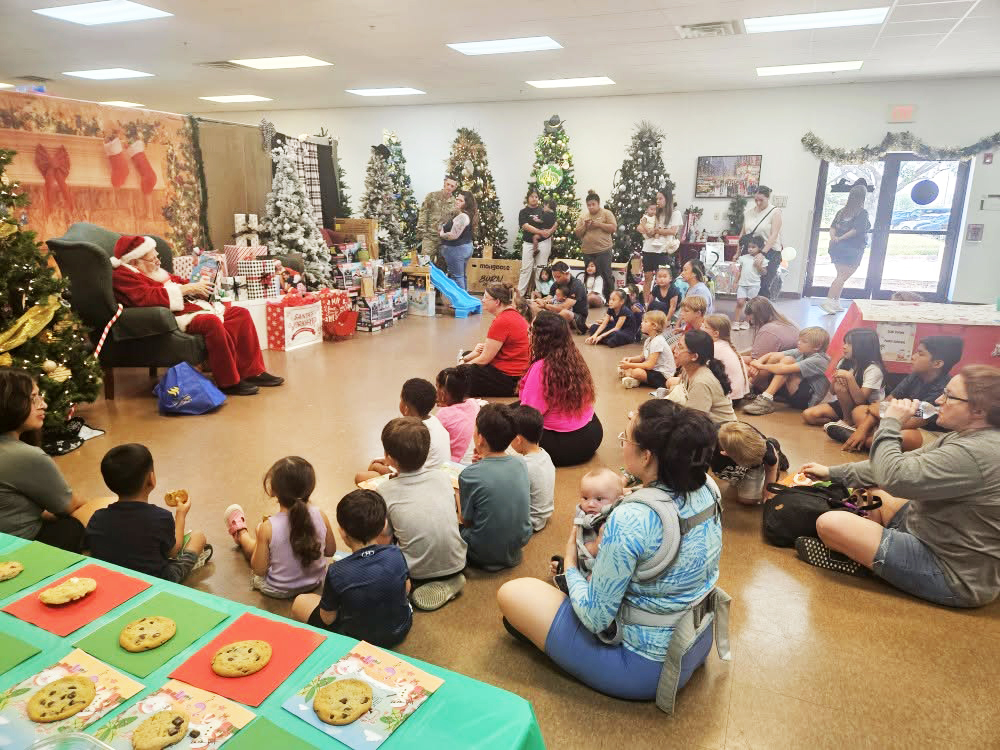
Around this time, Gauvey attended a function at Fort Hood for Santa’s Workshop, a nonprofit support organization for military families.
Right then and there, he volunteered to be their official Santa. He also donated four cases of his Santa’s Socks books for the families.
“I wanted to do something to let the troops know that there are people who support them,” he said. “I gave away thousands of books that Christmas to all the bases I could drive to.”
In 2003, Gauvey’s second year at Santa’s Workshop, they wanted to give a book to each family — 1,200 books. Gauvey happily donated them and his services again as Santa, and is now in his 23rd year of volunteering at Fort Hood. His favorite part of being Santa is talking to the littles and those children who have disabilities.
“The thing is — these kids — I know what they have in front of them,” he said. “I pray they have a happy young life, because I don’t know anyone who gets through life without any problems.”
Santa listens to a lot of hopes, dreams and requests from children, but one recent interaction will stay with Gauvey for the rest of his life. A young girl visited with him while her mom was busy at Santa’s Workshop. They talked for about 20 minutes before she had to go. Afterward, he learned that the chaplain had gone to her house just two weeks prior to tell her that her daddy was never going to come home. Her mom said that “Santa” was the only one her little girl had talked to since that terrible day.
“These are the opportunities that, when they come your way, you grab them and give them the best you got,” he said.
And so he does, taking his role as Santa seriously. He has created “reminder coins” that he gives to each child he sees at Santa’s Workshop.
On one side of the coin is his picture and on the other side the words, “Merry Christmas.” But what is special about this little token is what Gauvey tells each child:
“Santa doesn’t work only on Christmas Eve. You keep this coin in your pocket every day. And when it’s July and it’s hot and you’re playing with your friends outside and your mom calls you to come in, you look at that coin and remember to keep your mama happy because Christmas is coming!”
When it comes down to it, Gauvey is proud to have served his country and cares deeply for all the men and women who have served and are currently serving. And he’s still serving his country today in the guise of a red suit and a long white beard.
“When you join the Army, you’re giving your life to the Army. It’s dangerous work, and not everyone comes home. How do we do too much for them?”


