
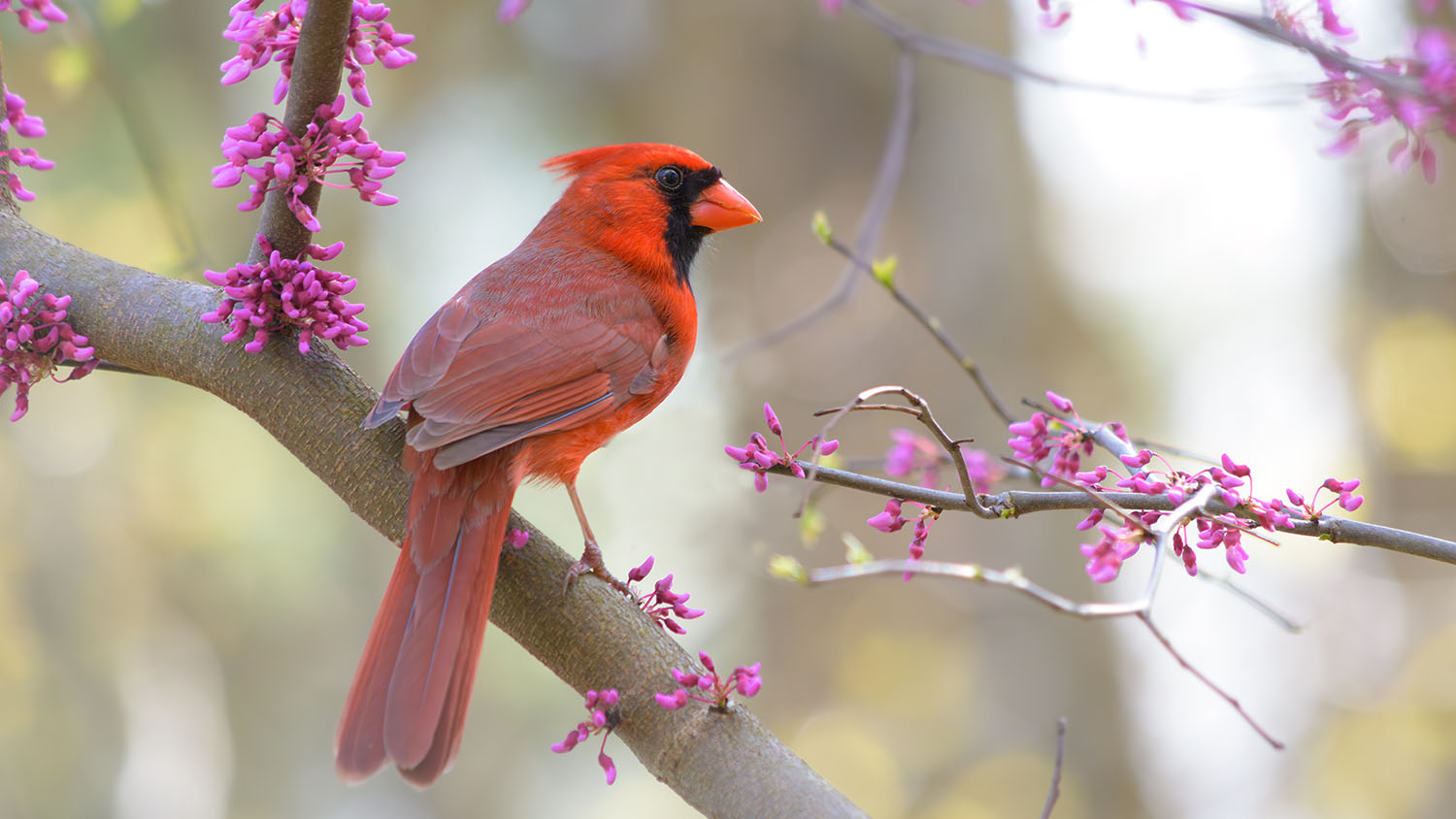
Cardinals Come Calling
By AMY ROGNLIE
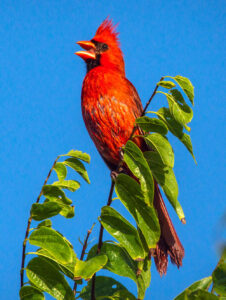
I’ve always loved watching birds. As a child, I had a bird-watching journal, in which I recall dutifully writing what I had observed in my yard each day, like three sparrows and one crow; and the birds I wished I had seen … like 15 bluejays sitting on a fence together or a red-winged blackbird landing on my sister’s head. I’m a bit more realistic these days, and I am particularly charmed with the common cardinals that are a part of daily life in Central Texas.
I recently watched a documentary on cardinals and learned all kinds of cool things about them that I thought I would share with you this time around. Apparently, cardinals are well-loved all over our nation, as seven out of our 50 states have chosen the cheerful, sociable cardinal as their state bird. I also learned that before it was outlawed to catch and keep wild birds, cardinals used to be kept as pets because of their eye-catching color and lovely songs.
Interestingly, both the male and female cardinals sing, which is unusual because in most other songbirds, only the male sings. In fact, female cardinals can sing longer and more complex songs than the males, often cheerily singing while they sit on their nests. What else would you do while sitting on eggs for weeks, right? Anyway, while the females sing lovely solos, a mated pair will often sing back and forth to each other, almost like a duet. Cardinals are some of the earliest of the early birds, often starting to sing well be-fore sunrise, though it would be hard for me to personally verify this, since I don’t willingly get up before dawn. Ever.
Cardinals have long been associated with love and romance, as they mate for life. The male can often be seen gently feeding the female a seed during courtship or while she sits on the nest, appearing to give her a kiss. They are highly attentive to each other throughout their relationship, and both the male and female participate in raising the chicks, which is a large job, considering that a single pair can have two to four clutches each year, with two or three chicks each time around!
Another crazy thing I learned is that cardinals practice “anting,” where a bird rubs live ants and other bugs on his feathers. Apparently, the ants then secrete formic acid, which acts as a repellent to parasites and may also act as a fungicide. Who knew? Also, cardinals are not red when they hatch. Not that I’d ever even thought to wonder about that. Well, I now know that their red coloring comes from carotenoids in their diet of berries, seeds and bugs. Bright red cardinals are considered the healthiest because the more carotenoids they eat, the brighter red they appear. I also learned that there are yellow cardinals, which is caused by a rare genetic condition resulting in a cardinal that has the distinctive crest and black face mask of a red cardinal, but the main color is a deep golden yellow. If I were eight years old again, I think I’d enter that one in my journal just because it would be so cool to at least pretend I’d seen one!
The Northern Cardinal is the only cardinal native to our region and loves brushy, wooded areas. If you want to attract more cardinals to your yard, sunflower seeds, safflower seeds and peanuts are some of their favorites. They also eat plenty of bugs, caterpillars, and even snails, particularly during the nesting season. And as always, make sure you have a water supply that is kept clean and trees or shrubs where they can hide. Though they are common, they will bring you a smile when you spot a flash of red or hear their joyful “cheer, cheer, cheer” or “birdie, birdie, birdie” call echoing across your yard.