‘We’re Excited’: AdventHealth’s Smart Rooms link patients to needed care
By ZACHARY WHITT | Photos by AdventHealth Central Texas
Exciting developments are unfolding in the world of medical technology and AdventHealth’s Smart Rooms initiative in Central Texas is a case in point. Naturally, while we may be familiar with seeing the word ‘smart’ everywhere, we still have to ask the question: what in the world is a Smart Room?
 Fortunately, AdventHealth Central Texas has its very own expert on the topic, Katy Mueller-Lampley. Currently serving as the Clinical Excellence Manager at AdventHealth Central Texas in Killeen, she has been at AdventHealth for fifteen years.
“Smart Rooms,” Mueller-Lampley explained, “is a technology that we use for our patients to keep them safer. It is also a way for us to link them to the care that they need faster.”
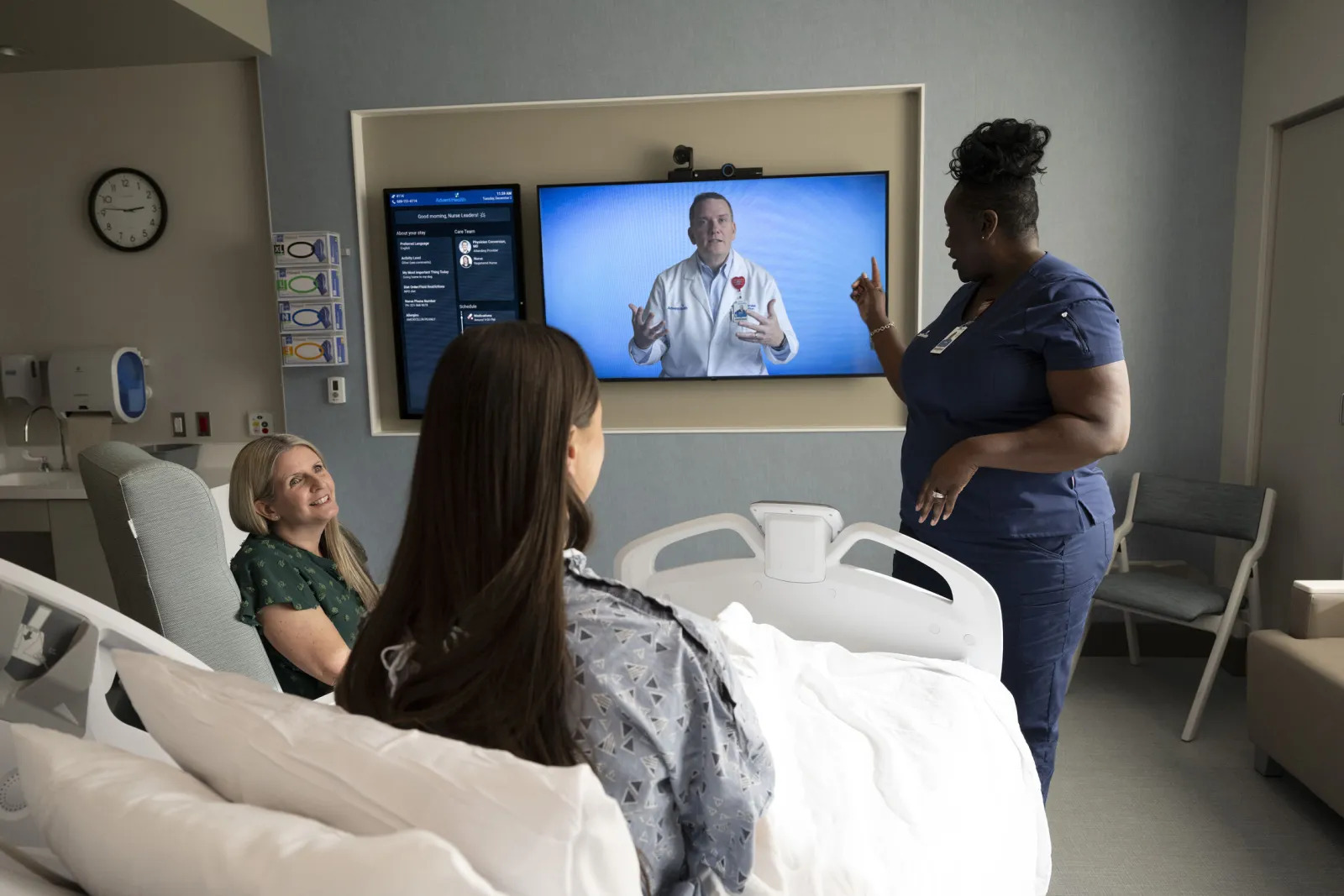
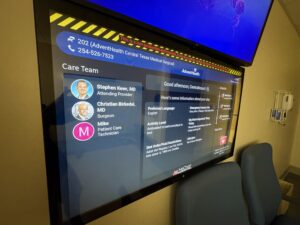
In addition to describing the capabilities of the rooms, Mueller-Lampley presented a demo room, one used for training. If the digital display mounted near the entryway went unnoticed, a visitor may not immediately realize they were standing in a Smart Room; however, this room has more than one TV screen.
“It is a touch screen TV essentially,” she detailed, “and it will pull information from the electronic medical record right to that digital whiteboard, so you’re going to be able to see things like your care team.”
There’s more though.
“And then,” she added, “we have the camera that is attached to the top of the TV, which gives the physicians or interpreters, any care team doing the virtual care, the ability to see the patient and anybody in the room.”
Mueller-Lampley stressed that while the Smart Rooms “makes it a lot easier to see everything that is going when it’s at the top of the TV and it kind of spans the room,” the camera, as a policy, requires the patient’s consent prior to it being turned on.
Mueller-Lampley said that while this latest project — a corporate initiative — started in March of last year, she has been in her current position as Clinical Excellence Manager for nearly three years. Consequently, she has acquired considerable experience, but while her role at AdventHealth sees her handling, and working with, exciting technological advancements, her day-to-day work revolves around people.
“I like helping our team members,” she shared, leaning forward with a smile. “That is my favorite thing. I teach every new hire that walks into this building, and they all hear me tell them, ‘I am a resource for you.’ I think back to when I started fifteen years ago. There wasn’t a ‘me’ in this role anywhere.”
Well, no longer. Working in a role that had not existed prior, she has found herself at the forefront of technological progress, as AdventHealth’s Killeen location is the first hospital in Bell County with these rooms.
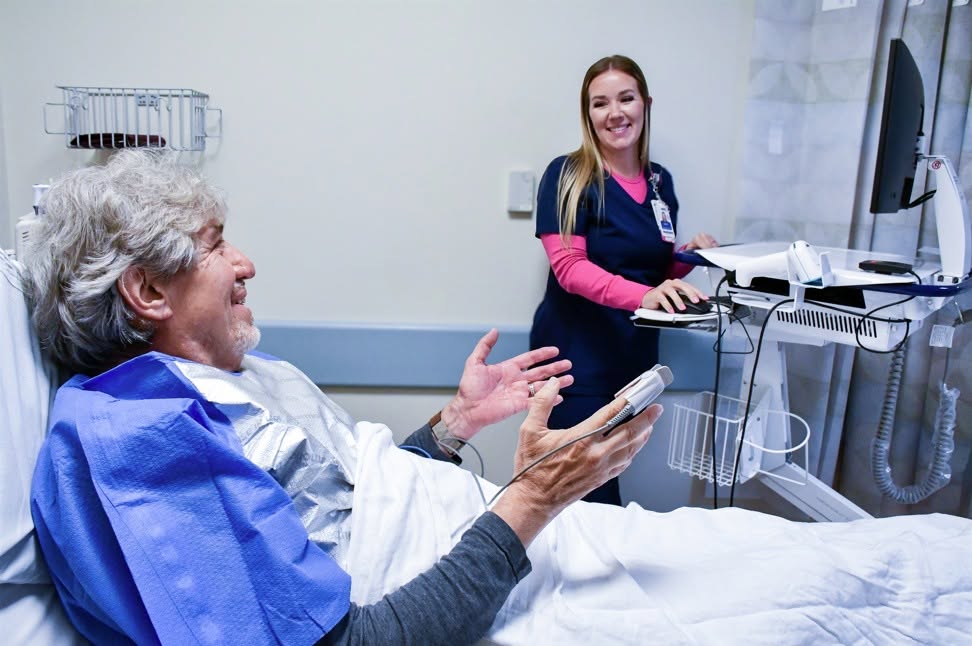
Astutely, Mueller-Lampley emphasized that the technology, in tandem with the location of the hospital, has provided AdventHealth Central Texas with an excellent opportunity to overcome an obstacle all too familiar to people with family members in the hospital, especially military families: distance.
Naturally, a remote connection can never substitute for being there at the bedside, but this technology offers an alternative.
Additionally, medical personnel benefit — and have already been benefiting — from the Smart Rooms’ capabilities. Mueller-Lampley illustrated this point with a hypothetical.
“So,” she said, “if we have a specialist that is not at the hospital — and let’s say they’re in clinic — they can remote into that patients’ room to have a consultation with the patient without having to come physically to the hospital.”
In describing AdventHealth’s reasoning for the undertaking this project, Mueller-Lampley emphasized quality of patient care, as well as speed.
“It factors into our safety metrics,” she explains. “It factors into the quality of care because they have a faster line to their care team, whether that’s a specialist, whether that’s a case manager that’s going to help them move on throughout their stay, maybe it’s chaplain service — we can connect them with the chaplain as well. If it’s the middle of the night and this patient wants to speak to a chaplain, we can call that chaplain on call, and they can virtually call into that patient’s room to provide that care for them.”
 The patient’s speedy recovery is the all-consuming issue. Mueller-Lampley stated that, historically, care teams have had to wait hours, or even until the next day to bring in a specialist.
“I think that anyone can agree you don’t come to the hospital hoping to stay,” she said.
Smart Rooms facilitate that process in numerous ways, big and small. From providing virtual consultations to saving nurses time from having to write patient information on a whiteboard, it supports efficiency without sacrificing the compassion.
Mueller-Lampley enthusiastically explained her favorite part of the Smart Room — a section on the bottom of the TV screen that is the patient’s top priority for that day.
“This is one of my favorite things. This is ‘my most important thing today.’ That’s going to be very different for a lot of different folks, right? That can change. I love being able to see what our patients think is their priority because then we can help them get to that.”
Referring to upcoming initiatives, as well as the progress made thus far, Mueller-Lampley simply said, “We’re excited.”
And in the world of medical technology and patient care, how could you not be?